From a site sketch to a purchase line
Use
Name the project: a kiosk, a trailer, a branch closet, or a temporary event. Indoor versus outdoor changes ingress protection. A plastic desktop case is not IP65. If IP65 is required, ask which clause was tested and on which model.
Documents
Request the datasheet, the connector drawing, and the FCC ID when an equipment authorization is in scope. Public FCC records attach to that ID. They do not follow a similar photo. An ISO 9001 file, if offered, describes a quality system, not radio performance.
Delivery stages
Split sample, bulk, and spares. Lead time should say whether it starts at drawing approval or at payment. US destination, Incoterm, and who clears duties stay visible. Commissioning is a separate line from the hardware.
Site constraints
Window glass, metal cladding, and cable length change the antenna choice. A 5 dBi whip and a 9 dBi panel are different quotes. Gain without frequency range is not usable. Keep the router transmit power in dBm on its own row so nobody adds it to gain by habit.
Selection table: handset port versus router port
| Dimension |
Handset accessory reading |
Business router reading |
| Connector |
Often a small proprietary or audio-style jack. Polarity rules for SMA do not apply until a drawing says they do. |
SMA, RP-SMA, or TS-9 at a stated 50 ohm impedance. Gender and polarity are mandatory cells. |
| Radio control |
The phone firmware chooses bands. A buyer cannot usually set channel width. |
Channel width, MIMO (2x2 or 4x4), and a management login may be selectable. Confirm on the model. |
| Power |
Battery inside the handset. Runtime is a phone question. |
DC barrel or Power over Ethernet. Class and watts go on the quote. |
| Evidence |
Service note for that phone revision. |
Datasheet plus FCC ID for the proposed router, not for the phone. |
Managed router versus a fixed modem
One view favors a managed router because VLAN and remote login help when several kiosks share a controller. The other view favors a simple modem or unmanaged gateway because fewer settings fail in the field and the installer does not need an account. Both can be valid. They are not the same line item, and a factory should not substitute one without marking the deviation. LinkScope Sourcing 31 keeps the choice on the brief.
Limits on this application page
- The desk cannot confirm that a named phone has an antenna port. That is a device-revision question.
- A router quotation does not improve a handset’s radio.
- Outdoor mounting hardware is excluded until the buyer lists the bracket, the jumper length, and the ingress target.
Procurement scenario: a kiosk team that started from a phone search
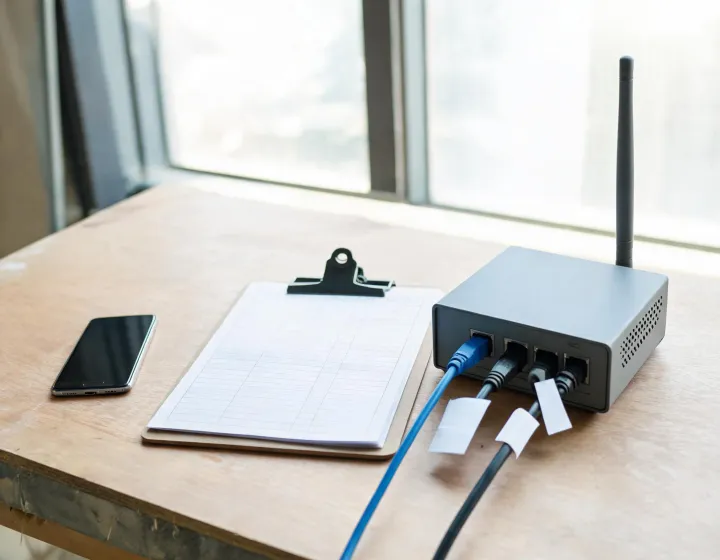
Background: the original note said “realme 9 pro external antenna port” because a technician had used a personal phone as a hotspot. The kiosks actually need sixteen fixed uplinks in Illinois, with antennas on a window mullion. Process: the rewritten sheet drops the phone as the item to buy, keeps the search phrase as context, and specifies a 4G router, 2x2 MIMO, SMA female, 50 ohm, bands left open for the factory to map, Power over Ethernet preferred, and a 1 m jumper as a separate line. Result: factories quote routers rather than phone accessories, and the phone phrase remains so nobody later “corrects” the file back to a handset. No throughput is published from the phone’s status screen.
Verification the buyer can repeat: read the connector drawing, match the FCC ID on the label to the public grant, then compare transmit power and receiver sensitivity with the datasheet row at the stated band. Temperature range on that row is the environment. If the row is missing, the cell stays open. See the inquiry cards or send the rewritten sheet from the contact page.