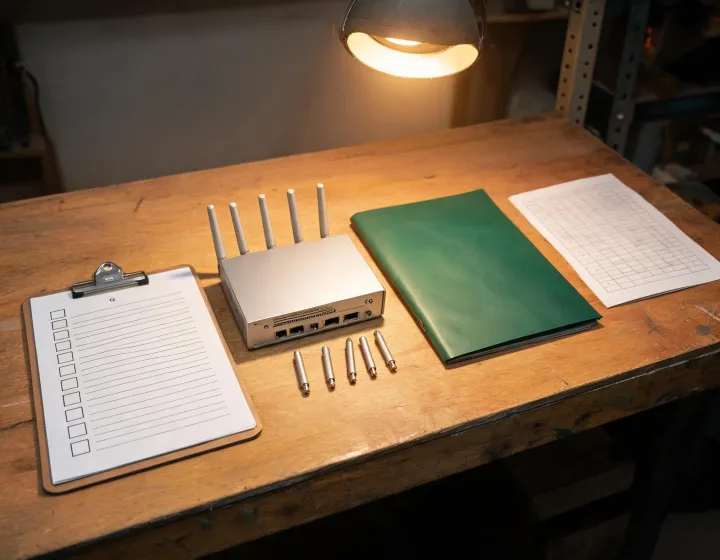
Quote scope that should stay unbundled
Radio and port
Frequency range written as band edges, for example a buyer may ask whether n78 around 3300-3800 MHz is supported. That range is a question, not a claim about a model on this site. Transmit power in dBm and receiver sensitivity come from the proposed datasheet. Antenna gain in dBi is a second document. VSWR, return loss, and insertion loss of a jumper are third documents. Do not merge them into one “RF quality” word.
Power, LAN, and optics
Power over Ethernet class, or a DC barrel voltage, is a cost line. If the router also switches LAN ports, ask whether switching capacity and forwarding rate are published. If an SFP WAN is required, ask wavelength, optical budget, and whether the plant is single-mode or multimode. A 1 rack unit faceplate is a freight and airflow question, not a radio question.
Commercial basis
Quantity, currency, per-unit or whole-order budget if you have one, Incoterm, destination, and lead-time basis. High-end, mid-range, budget-friendly, or undecided is a preference. It does not rank the factory. You can submit with the budget cell empty.
What an alternative must repeat
Exact manufacturer, model, and firmware branch. A compatible module may be offered against an OEM-coded module. Accept it only after host behavior, band list, and the test method are restated. A photo of four antenna holes is not a 4x4 MIMO proof if two holes are capped.
Trade-off: wider 5G carrier versus a narrower fallback
One argument for a wider channel, such as 100 MHz where the carrier and the module allow it, is higher theoretical throughput. The opposing argument is that a narrower 20 MHz or 40 MHz channel can be easier to match to a congested site and to a datasheet row the factory can actually cite. The checklist records which width the quote uses. It does not pick a winner. Throughput basis must say PHY, UDP, or TCP, and the direction.
Trade-off: external port versus a fixed internal antenna
An external port lets the buyer move the radiator to a window or a short mast, which matters when the rack is in a basement. The limit is connector polarity, jumper loss, and an ingress path at the chassis hole. A fixed internal antenna removes those variables and also removes the option to change gain. If the purchase reason is the port, an alternative without the port is a deviation, not a silent substitute.
Three limits before acceptance
- Band support is model-specific. A family name does not carry it.
- Conducted power into a 50 ohm load is not the same figure as radiated power with a stated antenna.
- Outdoor rating, license files, and spare antennas are excluded until the quote names them.
How a buyer can recheck a factory number
Environment: the temperature the datasheet names, often a room figure such as 25 C or the full operating range. Method: conducted measurement into 50 ohm, or an over-the-air note that states antenna gain. Data: the dBm row and the throughput row for the exact model and firmware. Steps: match the label FCC ID to the public equipment authorization record, compare the connector drawing to the pigtail in the carton, then mark pass or deviation. Measurement accuracy and calibration traceability are requested when the factory cites a lab instrument. If those files are absent in the reply, the cell stays open rather than being treated as confirmed. Connector mating cycle is relevant only for plugs that will be cycled; ask for the drawing note if the antenna will be removed weekly.
Procurement scenario: accepting a 5G alternative
Background: the original request was a named 5G desktop router with four SMA jacks. One factory offers a different chassis with two jacks populated and two capped, at a different lead time, destined for Arizona, quantity six. Process: the checklist forces the reply to restate MIMO as 2x2 rather than 4x4, to restate channel width, to price a 0.5 m jumper separately, and to attach the datasheet row for transmit power. Result: the buyer can see the port-count change before anyone calls the unit equivalent. The desk does not calculate a percentage difference between the two prices.
Related pages: inquiry configurations and the procurement brief.